

Did this pole really need to go here?
For years I've been battling with Auckland Transport to try address the lack of pedestrian crossings on the Mt Wellington Highway near Sylvia Park. Not just a major shopping destination, it's also a transport hub for the area but there's gaps in the footpaths.
For years I've been battling with Auckland Transport to try address the lack of pedestrian crossings on the Mt Wellington Highway near Sylvia Park. Not just a major shopping destination, it's also a transport hub for the area but there's gaps in the footpaths.
I recently noticed roadworks underway on one of the on ramps and what appeared to be a new pedestrian crossing. My excitement was quickly dampened when I discovered this pole had been placed right in the centre of the new footpath.
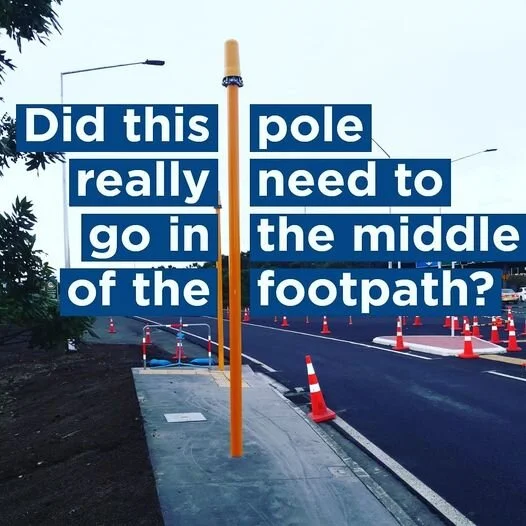
It's clearly a hazard, especially for people with wheelchairs, prams or mobility scooters. Not sure who's fault it is but clearly it doesn't belong here.
I've asked AT what is happening...

Where's my bus?
I'm meant to at a sustainable business event, talking with other local young professionals about what we can do to tackle climate change. Huge challenge we have to face.
But instead I'm standing at a bus stop waiting for a bus that may never come.
I'm meant to at a sustainable business event, talking with other local young professionals about what we can do to tackle climate change. Huge challenge we have to face.
But instead I'm standing at a bus stop waiting for a bus that may never come.
I use public transport as my primary means of getting around Tāmaki Makaurau - bus, train and the odd ferry. There's lots to enjoy, but the reliability is an issue that we must address. Accessibility and affordability also big concerns.
Apparently I missed my connecting bus (or it never turned up) and the next one couldn't fit in the Ōtahuhu station so just drove past. Now I'm late because I tried to do the right thing and not drive.
So much for the Climate Emergency Auckland Council and Auckland Transport

Road safety needs to be taken seriously
It's Road Safety Week and Auckland Transport have shown their support. But what we need is action.
It's Road Safety Week and Auckland Transport have shown their support. But what we need is action.
For all the promises of Vision Zero, there's too many issues being ignored. People are being hurt and killed, it's shameful. Last year 37 people were killed on Auckland roads and nearly 500 were seriously injured.
On paper Auckland has some great plans and strategies to make our city safer. But in reality, the focus shifts and the funds evaporate.
Not enough pedestrian crossings, too many missing legs.
Not enough protected cycleways, too much mixed traffic.
Not enough enforcement of rules, too many bad habits formed & endorsed by lack of action.
Not enough action, too much talk and promise.
In East Auckland we've seen primary school kids left to fend for themselves, forced to share roads with heavy construction vehicles and no footpaths while council debates who funds the solution. Thanks to the tireless work of their caring school and community, it's being addressed but it shouldn't take so much effort to keep people safe.
I don't blame the staff at Auckland Council or Auckland Transport - these issues are cultural and systemic. They're driven by poor governance, confused strategy and a lack of political will. Last year's Emergency Budget saw safety funding cut which our Councillors and Mayor knew would increase injuries and deaths but they voted for it anyway. If we were serious about safety (and we should be) then we'd prioritise it, not defund it.
In the meantime, travel safely and look out for others.
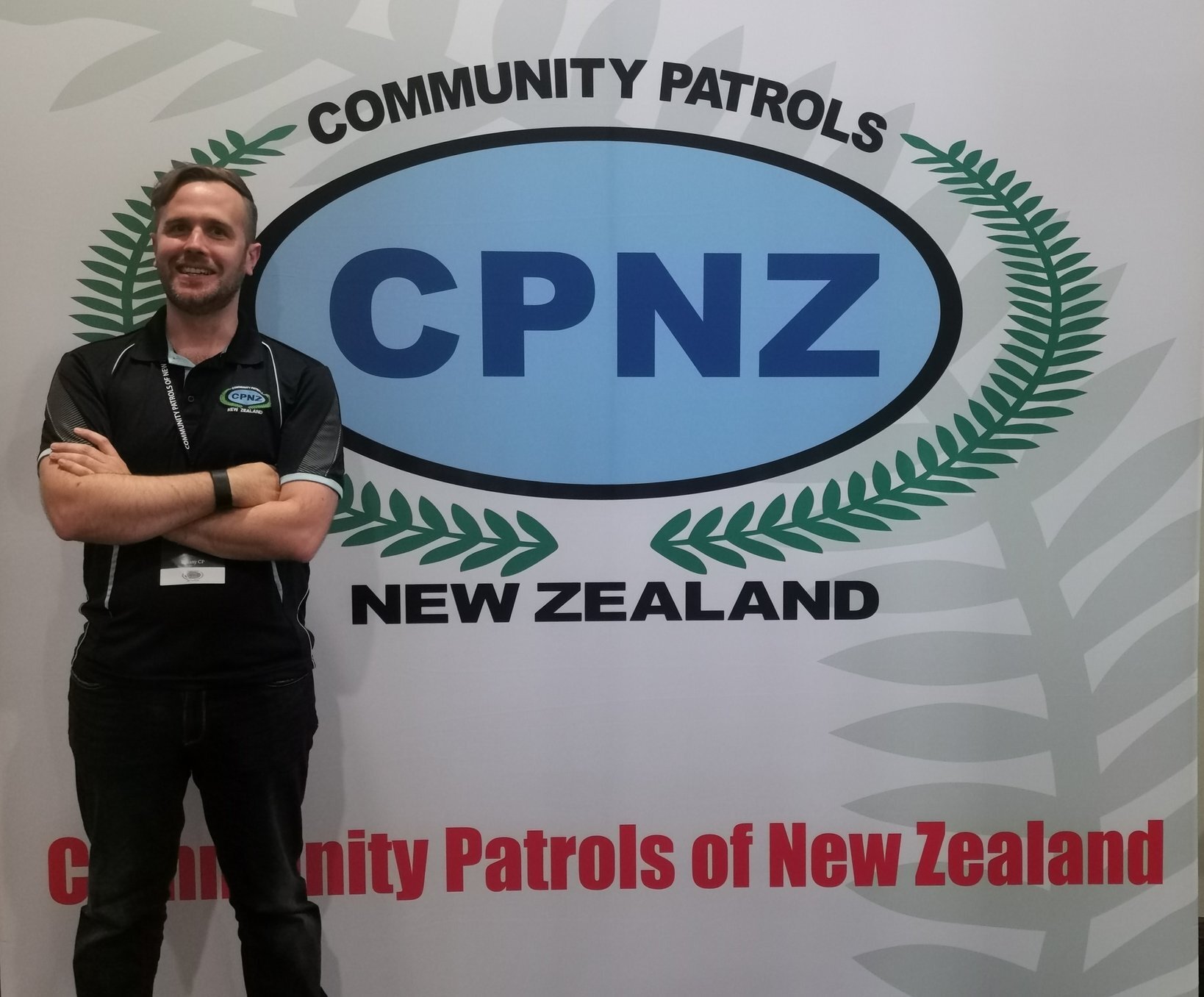
Community Patrols NZ conference
In mid-March I spent a weekend in Palmerston North at the Community Patrols New Zealand leadership conference representing Botany.
In mid-March I spent a weekend in Palmerston North at the Community Patrols New Zealand leadership conference representing Botany.
It was great to learn from the Commissioner about our partnership with NZ Police and make some great connections with volunteers across Aotearoa.
CPNZ is made up of 170 community patrols across the country who volunteer as the eyes and ears of the NZ Police to keep their community safe. We’re always looking for more volunteers!


Selling parks and reserves won't fix anything
Stunning Saturday afternoon for a community meeting in Aberfeldy Park in Highland Park. Sadly this park is on the list for potential sale under Auckland Council's so called "asset recycling" programme which will see over $224m in community assets sold.

Stunning Saturday afternoon for a community meeting in Aberfeldy Park in Highland Park. Sadly this park is on the list for potential sale under Auckland Council's so called "asset recycling" programme which will see over $224m in community assets sold.
While I'm not ideologically opposed to asset sales, selling our reserves and greenspaces is something else entirely. As our city continues to grow and housing is intensified, these spaces become more important. Once gone, we'll never get them back. It's short sighted and fails to address the issues of waste and misspending.
Disappointed that neither of our Councillors could be there to hear concerns and explain their part in the decision making. Both voted for the asset sale programme in the Emergency Budget, although they did vote against the sale of these specific parks in a later meeting.
Big thank you to local MPs Christopher Luxon and Simeon Brown for organising the meeting, making sure that locals are aware of the issue and are heard.
Formal consultation is due to start sometime in February and locals are coordinating to ensure everyone is able to respond with full and complete information.


Auckland Transport is increasing fares, yet again.
In what feels like deja vu, Auckland Transport is yet again increasing the fares for public transport. From 7 February about half of all passengers will pay an average 35 cents more for each trip. In 2016 they reworked the fare structure and every year since then fares have gone up. Last year they blamed petrol prices and this year it's COVID19. The reality is that Auckland already has one of the most expensive public transport fares in the world and making it more expensive is only making our transport issues worse.
In what feels like deja vu, Auckland Transport is yet again increasing the fares for public transport. From 7 February about half of all passengers will pay an average 35 cents more for each trip. In 2016 they reworked the fare structure and every year since then fares have gone up. Last year they blamed petrol prices and this year it's COVID19. The reality is that Auckland already has one of the most expensive public transport fares in the world and making it more expensive is only making our transport issues worse.
Auckland Transport and Auckland Council are selling these changes as a win by focusing on the 10% discount for off peak fares. We do have spare capacity in our off peak services and encouraging people to use this is a great way to smooth peak demand. But practically most people commuting to work, school or university will not be able to delay their trips to take advantage of this. They've also introduced a daily fare cap which should be a great way to encourage multiple trips. I’m a big supporter of a daily cap but setting it at $20 a day means it won’t do much to offset the increased costs.
While this decision comes from Auckland Transport, it’s ultimately Auckland Council who are accountable as they set the priorities and budget for the CCO. Auckland Council says it’s aiming to halve greenhouse gas emissions by 2030 and with transport making up nearly 40% of Auckland’s carbon footprint, getting people into more efficient forms like public transport is a must. Our council declared a climate emergency in 2019 but has continued to increase the cost of fares, driving people back to private vehicles.
These increases are apparently going to save $4.3m but we're kidding ourselves if we think that this makes good financial sense - congestion alone costs our economy hundreds of millions of dollars a year. A study in 2017 suggested that the cost of congestion in Auckland was $1.3B a year or $3.5m a day in lost productivity. Improving the capacity, design and state of our roads will help address this but to get real change we need to get people onto mass transit.
Public transport won't work for everyone in every situation but it should cater for most people's daily commute. And the more people that use it, the less traffic on the road for those who can't. I use public transport to commute to and from work every day and, while it’s not perfect, it's generally reliable and stress free. We still get stuck in traffic, but I can listen to music or read and the short walk to and from the stops has been good for my physical and mental wellbeing.
Across Auckland we are investing in transport which is fantastic. Many of the biggest projects underway around the city are transport related - CRL, Eastern Busway, Airport to Botany. These projects are delivering the much needed capacity and reliability to the network that we need to cater for our fast growing population.
But all of this will be a massive waste of money if it's too expensive to use! And Auckland Transport knows this, admitting that 556k less trips a year will happen on public transport as a result of these increases. Trips that will end up in private vehicles which means more emissions, congestion and crashes. Our city is growing fast and we're decades behind in transport infrastructure and services, cutting corners now is just kicking the can down the road again, a very congested poorly maintained road.
If Auckland Council and Auckland Transport are serious about addressing climate emissions, reducing congestion and making our city safer they will reduce, not increase the prices for public transport.
Reflecting on 2020
As we head into 2021, I've been reflecting back on the previous year. 2020 was a lot and certainly not the year I’d planned for! It's tempting to write it off and pretend it didn't happen but amongst the chaos there were still good times.

As we head into 2021, I've been reflecting back on the previous year. 2020 was a lot and certainly not the year I’d planned for! It's tempting to write it off and pretend it didn't happen but amongst the chaos there were still good times.
Work was full on, challenging at times but ultimately rewarding. I’m proud to have worked for an essential service that put people first but still managed to provide services to the primary industries throughout a rough year. That we could transition to a new CEO so smoothly is a testament to how well we pulled together for our shared vision. Very busy year and I loved my break, to recharge and unwind but I'm already back to work tackling some big changes.
Professionally my focus has been on my governance experience and skills. Mid-year I joined the Institute of Directors and have since attended a number of training courses, meetings and social events meeting some amazing people and learning a great deal in a short time. I’m putting this to use as a director of two commercial subsidiaries and the three community groups I volunteer with.
On a personal level it’s been tough getting the work/life balance right, especially when the physical separations vanished. Got things back on track with the help of friends and family, some well established disciplines that are working well. None of it would’ve been possible without my amazing partner Josh, who is always there to motivate and support me. We survived both lockdowns stuck at home, our relationship feels stronger for it!
Last year saw some big changes for my family. One of the most significant was farewelling the Light family home. It was the house that my father and grandfather built before I was born, in the then-undesirable Devonport. Four decades and a few additions later, a lot of memories formed and shared in that house. We lost the building to a fire a few years ago (no one was hurt), so it was just an empty section but still hard to say goodbye to a place that has been part of our life for so long. New chapter for my parents and for us all as they move to a new home (not too far away).
In other new beginnings we welcomed another member to the family with our newest nephew, the delightful Hugo born to my brother and his fiancé in August. I managed to sneak in a visit between lockdowns for a quick cuddle. He's already an awesome little dude and I'm looking forward to getting to know him better as he grows up. There were some other significant birthdays which we managed to celebrate and recognise depending on restrictions at the time. Family video conferences were suitably chaotic and fun.
While the pandemic has changed a lot, life still moves on. And we sadly had some extended whanau pass away last year. Losing anyone is difficult, even more so with the restrictions in place. Much like ANZAC Day, we learned to commemorate and grieve apart but still together. We also had a number of health scares for close family and friends, which can hit hard especially when physical interaction wasn't always possible.
It reminded me that I’ve lost touch with some people I didn’t mean to, some of it was lockdown related but other times it’s just life getting in the way. Will try to do better in 2021!
That’s not to say it was a lonely or quiet year. Despite the social and physical distancing, I met new people, as well as the amazing humans I already have the pleasure of knowing. We volunteered, we collected rubbish, dressed up in costumes, celebrated, commiserated and shared in a very unusual year.
We closed out the year with a neighborhood street party on Christmas Eve. We're fortunate to know our neighbors well and the residents of our street have supported each other through some challenging times. So after a year of social distancing, it was nice to celebrate together and welcome the newer members to the street. The wide range of cultures reflected in the food with BBQs, dumplings, curries, braai and more. First time we've done it but there's already talk of doing it throughout the year which is awesome.
Wishing everyone the very best for the New Year.

Inaction, waste mar the first decade of Super City - NZ Herald
After a decade of vanity projects, wasteful spending and empty gestures, Auckland Council’s abysmal financial management is finally catching up with it. While some may delight in its downfall, the residents and ratepayers are left to face the brunt of its inept management.
"After a decade of vanity projects, wasteful spending and empty gestures, Auckland Council’s abysmal financial management is finally catching up with it. While some may delight in its downfall, the residents and ratepayers are left to face the brunt of its inept management."
On Monday the NZ Herald published an opinion piece from me about the spending issues at Auckland Council.
Like many Aucklanders, I'm frustrated that Council has wasted it's first decade with poor financial decisions and missed opportunities. Basics like park maintenance, road safety and public transport have suffered while money was poured into vanity projects. We're now facing a massive revenue shortfall and services are being cut, while rates and debt continues to rise.
Soon Auckland Council will begin it's consultation on the next Long Term Plan for the next 10 years. We need to ensure that we get our priorities right, or we'll be having this same discussion in another decade.

My opinion piece in the NZ Herald Monday 30 November 2020

Selling land is short sighed
I'm not ideologically opposed to asset sales - sometimes it makes sense to sell some unused land to fund something better and more useful for the community. But selling them to fund a shortfall in revenue means we're loosing out, especially when it's clear that even this massive selloff will do little to plug the gap.
“The council’s finance and performance committee voted in September to dispose of a swath of council-owned properties across the city. The move is part of an effort to raise $224 million from “asset recycling” through the council’s emergency budget.”
This was one of my major issues with the Emergency Budget - a firesale of over $200m worth of assets is extremely shortsighted and will do nothing for the long term viability of our city.
I'm not ideologically opposed to asset sales - sometimes it makes sense to sell some unused land to fund something better and more useful for the community. But selling them to fund a shortfall in revenue means we're loosing out, especially when it's clear that even this massive selloff will do little to plug the gap. There's also a very real concern that the timing of these sales and the volume will only hurt the value of the properties, further reducing the return.
These decisions are being made without consideration of the long term plans for the area. The decision to sell has disregarded local feedback, including the Howick Local Board which was extremely clear (and fair) in their feedback. Panuku (Auckland Council's development arm responsible for managing this process) have a long history of being extremely opaque and I echo the concerns of many that this process won't result in good outcomes.
It's great to see that our two councillors (who voted for the Emergency Budget) have now voted against these sales. It's also good to see two of our local MPs are adding their voice to this.

Lack of skatepark needs to be addressed
When it comes to parks and recreation, what we do have is often too small or desperately out of date. Lloyd Elsmore Skatepark isn't just outdated, it's dangerous.
East Auckland is one of the largest and fastest growing parts of Auckland, yet we lack some basic facilities. When it comes to parks and recreation, what we do have is often too small or desperately out of date. Lloyd Elsmore Skatepark isn't just outdated, it's dangerous.
In the park on Tuesday I heard horror stories of injuries sustained, including glass in head wounds. Other parents refused to let their children use it, driving them to Barry Curtis or even into the city instead. Neither is acceptable - we need to do something with Lloyd Elsmore.
While not a skater myself, I know the difference a decent skatepark can mean. Some of this is because I've seen the success in other parts of Auckland (eg Birkenhead, Wellsford, Papakura Glenfield, Waiuku). I've also spent a lot of time talking to locals about this issue - families, parents and young people all asking for somewhere safe to skate. The request isn't unreasonable and council openly admits it hasn't done enough to maintain the park, getting distracted with other projects.
Funding comes down to priorities, driven by public demand. And there's plenty of demand - last year we got thousands of signatures asking for a solution, but still nothing. Since then we've been working to build more support and I'm happy to throw my voice behind this latest push to get it sorted.
One of the gaps has been the lack of collective voice - so locals are organising to make sure their voices are heard. Your support is welcome at www.facebook.com/refurblloydelsmore

Council should be investing in the safety of our children
We've got our priorities wrong Auckland, keeping our kids safe should be at the top of the list. More students walking and cycling is better for congestion, the environment and children’s health. Instead our city gets distracted with half-baked ideas for waterfront stadiums. We need to focus on real priorities, cut the fluff and get on with it.
Last night was the Howick Local Board meeting for November, a little over a year after the new Board was sworn in. A lot has changed since then and our elected representatives have had to tackle some tough challenges, including a global pandemic that not only changed how we live and work, but also massively impacted the council’s revenue streams and therefore its ability to operate.
There's been plenty of coverage over Auckland Council’s financial troubles, the drastic (and in my view poorly considered) cuts to the city budget earlier this year far from over. Even if the COVID19 vaccines are as successful as we all hope, it'll be sometime before council revenue returns to its previous levels - the cuts will be here for a while.
One of the worst decisions was to cut back the road safety funding, including the end of the Community Safety Fund - once the flagship of the Vision Zero programme. Dropping this not only sent the wrong message that we should simply accept more deaths and serious injuries to save a few dollars, but also put critical projects at risk.
Once such project was the Flatbush School Road bridge. Once a small rural backroad, this area has grown quickly with massive housing developments and a new school, Te Uho o te Nikau Primary. Sharing this tiny bridge with increasing traffic, including large trucks, put the students at risk. I witnessed the dedication and persistence of the school as they turned up at every Howick Local Board meeting asking for action. After far too much debate over which part of Auckland Council would fund the project, it ended up with the Community Safety Fund. As the process rolled on, COVID hit and the Emergency Budget saw the end of the fund, leaving the bridge in question.
One silver lining from last night's meeting is that this critical project will continue, funded by Auckland Transport directly. A small delay due to consenting means the bridge should be done in February or March 2021. Great news for the Board, Management and Parents of Te Uho o te Nikau Primary School who worked so hard to keep their students safe.
It's a good news story for these students, although it should’ve come sooner. But too many other children around Auckland still have no safe walking or cycling options. On Twitter yesterday I saw parents lamenting the lack of safe access to schools across the city. While there is some work underway, it’s small programmes and pilots - nothing that will seriously shift the gears into action.
I appreciate that this year has left Auckland Council with less ability to respond to issues. But this only highlights the need to get these projects done earlier, quicker and with urgency. Imagine if we'd spent the $900k wasted on yet another stadium report on improving safety around our schools? Or the $10m given away to Eden Park? Or whatever AT Local cost?
We've got our priorities wrong Auckland, keeping our kids safe should be at the top of the list. More students walking and cycling is better for congestion, the environment and children’s health. Instead our city gets distracted with half-baked ideas for waterfront stadiums. We need to focus on real priorities, cut the fluff and get on with it.
Auckland Council's ineffective governance of CCOs
Considering the massive impact that CCOs have on our daily lives, you'd imagine that they would be a top priority for Council. But in reality "council’s many plans, policies and strategies offer almost no practical strategic direction to CCOs."
Auckland's Council Controlled Organisations (CCOs) account for 2/3 of the services provided to the public, control 2/3 of councils assets and make up half the operational budget.
Considering the massive impact they have on our daily lives, you'd imagine that they would be a top priority for Council. But in reality "council’s many plans, policies and strategies offer almost no practical strategic direction to CCOs."
In fact "in some crucial areas – such as water, property and arts and culture – there is no strategy at all." Perhaps caused by "a lack of commitment by some councillors" and the "insufficient face-to-face discussion and meaningful dialogue between CCOs and the governing body".
Those aren't my words (although I agree with them wholeheartedly) - these quotes come from the CCO Review that recently found that the "council’s governance of, and liaison with, CCOs is not working as it should". This is no surprise to Aucklanders who have to live with the erratic performance of these organisations, battling between silos and getting very little in response. And it's not just us, with CCOs "not sufficiently responsive to local boards’ concerns".
Yesterday Auckland Council formally adopted all of the 64 recommendations from the review. Of those, 25 are to be progressed over the next 6 months while the others will be worked through with the CCOs and local boards. This is undeniably great news and is a significant step forward.
How much actually changes, only time will tell. But when you look through the recommendations, it's disappointing to see that there are clearly significant gaps in basic governance and accountability.
This isn't a dig at the recommendations - they're solid. But it shouldn't take public outcry and a costly external review to agree that "quarterly meetings of council and CCO executive leadership teams have a formal agenda". That's basic business practice not followed and it gets worse as the review goes on.
Auckland Transport and Watercare are constantly criticised for their maintenance and lack of planning, yet only now will they "submit their asset management plans and detailed supporting information to the council every year so it can assess how well the plans give effect to its urban growth strategy." It's no wonder that our infrastructure isn't coping with our rapid growth, despite all the election promises we heard.
At the risk of sound like a stuck record, Auckland Council lacks proper governance and oversight. Many of the councillors elected have little to no business experience, yet they're responsible for one of the largest budgets in the country (second only to central government). Perhaps this review will be a wake-up call for those charged with governing our city? Past performance says that's unlikely, but I'm always hopeful for our city.
Read the full review here: https://www.aucklandcouncil.govt.nz/about-auckland-council/how-auckland-council-works/council-controlled-organisations/Documents/CCO-review.pdf
Read the Governing Body decision here: https://ourauckland.aucklandcouncil.govt.nz/articles/news/2020/08/council-agrees-cco-review-recommendations/

Point View Drive gets another community clean up
Point View Dr offers some stunning views over East Auckland, but unfortunately some people dump rubbish which ruins it for everyone. Today we had 2nd annual clean up, organised by Howick Local Board Member Mike Turinsky

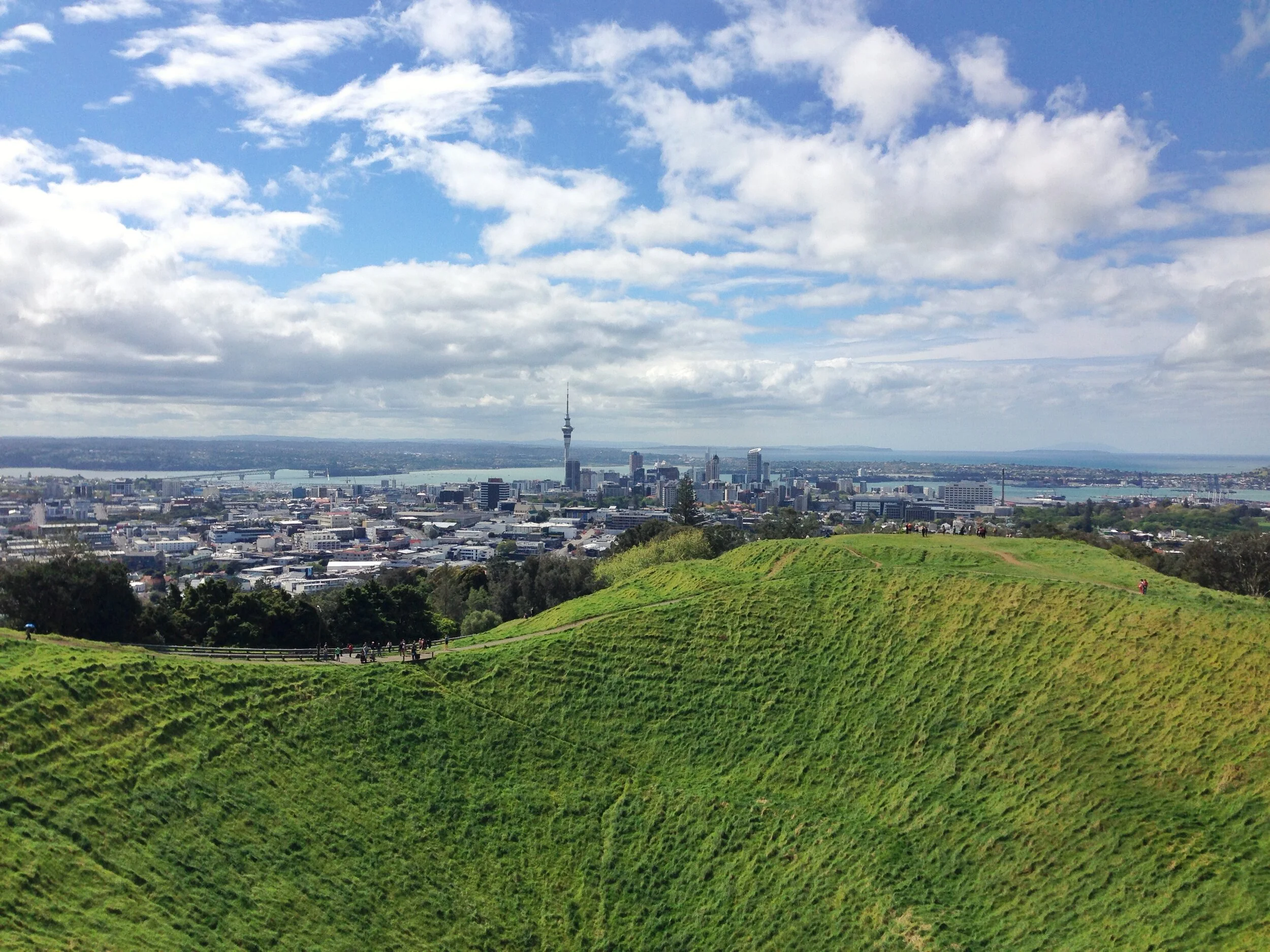
Point View Drive offers amazing views across East Auckland
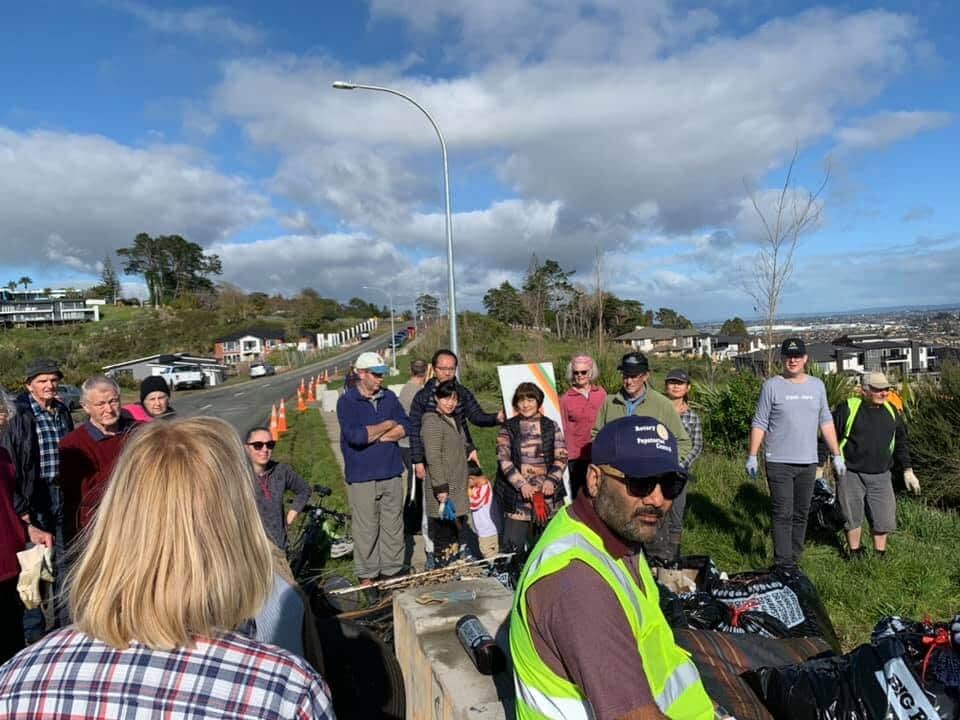
Lots of volunteers turned up to help clean up the site
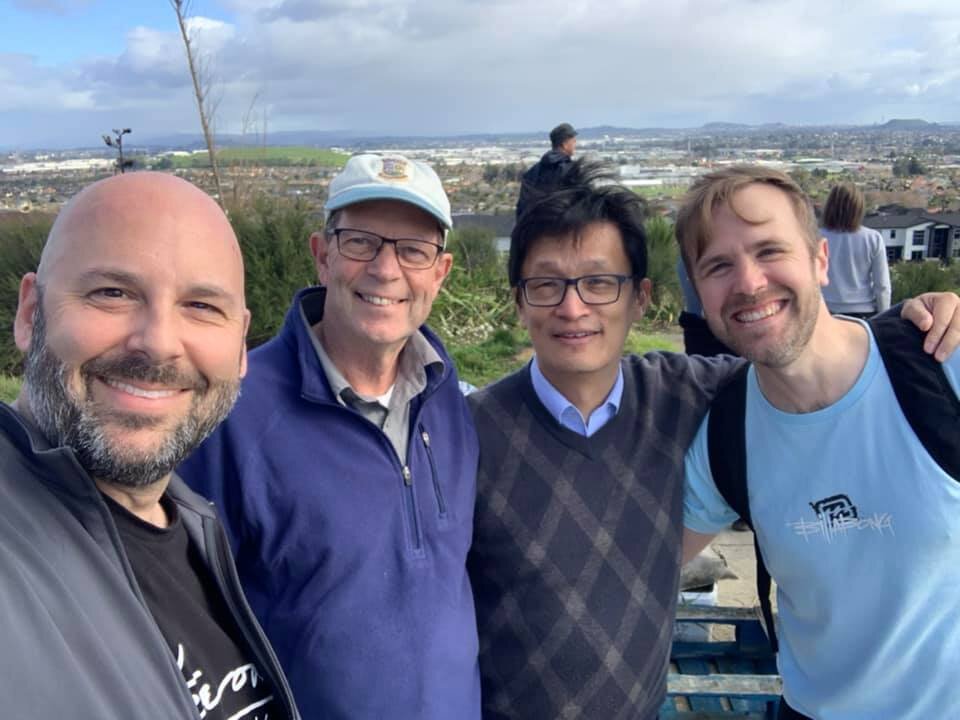
(left to right) Mike Turinsky (Howick Local Board) John Spiller (Howick Local Board), Paul Young (Howick Councillor) and me.
Point View Dr offers some stunning views over East Auckland, but unfortunately some people dump rubbish which ruins it for everyone.
Today we had 2nd annual clean up, organised by Howick Local Board Member Mike Turinsky (he organised the event last year as well). We removed lots of rubbish thanks to the generous local volunteers who gave up a few hours of their Saturday morning to make it happen. So disappointing to see the amount of bottles, plastic and polystyrene littering the environment.
Good to see this supported by local politicians with John Spiller (Howick Local Board Member), Paul Young (Howick Ward Councillor) and Naisi Chen (Labour's candidate for Botany).

Cockle Bay long history of advocating for improvements continues
The Cockle Bay Residents and Ratepayers Association has existed since the 1930s, advocating for the needs of locals and to ensure it remains a beautiful place to live.

Nearly a hundred local residents came to listen, discuss and advocate for a better Cockle Bay.
The Cockle Bay Residents and Ratepayers Association has existed since the 1930s, advocating for the needs of locals and to ensure it remains a beautiful place to live.
At today's AGM, we heard about the work that they have been up to over the past year and it’s been another busy one. They’ve been working with concerned locals on the Sandspit Road development which has been a long and ongoing battle. The first hurdle to overcome was to get clarity on the definition of what an IRD (integrated residential development) meant and if it was intended to allow for more than just retirement homes. Together with a new consent application from the developer, the situation was still evolving and the Committee was working to understand the process going forward before seeking further public support.
They provided support to locals during lockdown and have been working to ensure the sustainable future of the cockles that give the area its name. They’re awaiting some scientific studies on the smaller species of shellfish. It was great to hear they’d submitted on the Emergency Budget, providing some practical suggestions for savings as well as alternatives to funding such as user pays. It was also pleasing to hear that they felt that there had been a cultural shift on the Howick Local Board with the engagement with the association significantly improving. While the Association had not been successful in their application to get the walkway between Cockle Bay Beach and Pah Rd upgraded, they were now working towards getting the bamboo cut back.
As Chair, Laurie Slee has done an amazing job of leading the organisation through some extremely complex issues while maintaining strong advocacy. He was once again reelected as Chairperson without opposition which is a reflection of the confidence locals have in his leadership. As treasurer, Grant Taylor has ensured the organisation has remained financially sustainable and was also reelected unopposed.

Alan La Roche giving his talk on local history, filled with facts and laughs.
Then local historian Alan La Roche gave a fantastic talk on the history of advocacy in the area, filled with humorous anecdotes. He noted that the residents association (then called Cockle Bay Residents and Improvement Association) was formed in the 1930s with the aim of getting changing sheds for swimmers, street lights and improved roads. At the time the area was largely bachs, but as this changed the association advocated for more, including connection to the Auckland water supply to (somewhat ironically) avoid droughts. In the 1960s, proper sewage connections were established which saw the end of septic tanks in exchange for a 30% rates rise. He recalled as a child swimming through sewage at Cockle Bay to get out into the clearer waters, which at the time didn’t seem like an issue. While attitudes have changed dramatically, Alan also mentioned that the planned development of Whitford Manor had been approved to discharge treated sewage into the Turanga estuary. Seems we still have a lot to learn from history and need strong local groups to advocate for our people and environment.
It was a great turnout this morning and together with the hard work the association has been doing, I’m confident that the locals of Cockle Bay are being well served by their association.

Politics is harder than most people know
It's physically, emotionally and financially draining. Most candidates/politicians I've met, do it because they want to make a positive difference, they give it everything and it quickly becomes all consuming.
Politics is really hard, harder than most will know. It's physically, emotionally and financially draining. Most candidates/politicians I've met, do it because they want to make a positive difference, they give it everything and it quickly becomes all consuming.
You're under pressure from other politicians, the media and public. We want candidates who can respond to a wide range of topics yet be open to new ideas, we expect them to be open and honest as well as tough and resilient. Plus the pressure that we put on ourselves.
And that all comes with the job, running a city or country is hard work and the process to select the best should be robust. But too often it's about who has the most money, loudest voice or most attention grabbing stunt. You have to put up with armchair experts, abuse and worse.
This all takes a massive personal toll. Anyone who has been a candidate (or knows one well) well attest that it's impossible to do without strong support network, friends and whānau. I'm eternally grateful for my family, friends and volunteers who've helped me on countless campaigns.
But ultimately it's you up there, with your name, your face and your reputation on the line.
Politics can be really enjoyable. It's a challenge but can also be very rewarding. When I reflect on the opportunities I've had, the people I've meet and things I've learned through the years, it's worth it.
We need to hold our candidates/politicians to account, demand a high standard and encourage the best. But we also need to remember we're still talking about people. Passionate, dedicated & decent kiwis trying to make our world a little better.
Be critical but be constructive.

Howick Local Board feedback on Emergency Budget
On Thursday evening last week I attended a special Howick Local Board meeting. Timed to allow the members to consider feedback from locals on the proposed Emergency Budget before it goes to council.
On Thursday evening last week I attended a special Howick Local Board meeting. Timed to allow the members to consider feedback from locals on the proposed Emergency Budget before it goes to council.
Some interesting insights into some of the 2,549 responses from the Howick Local Board area. 51% voted for a 2.5% increase, while 27% voted for a 3.5% increase. 65% voted in favour of the rates postponement scheme and 72% for the suspension of the targeted accommodation rate and it’s linked tourism projects. Some other themes that came out which I’d love to explore in more detail at some stage.
The Board responded with feedback not just to the main questions, but in quite a bit of detail which was good to see. I did live tweet the decisions but there were a lot to cover (took 3 hours) and I'd prefer to wait till the minutes were up. Here are a couple of highlights
only support 3.5% rates increase based on the impact that 2.5% would have on ability for council to deliver and with proviso's to limit asset sales;
only support reduction in Local Board Transport funding if Community Safety Fund is retained;
do no support the delay to Ormiston Community Centre and Library;
do not support deferrals in stormwater projects, especially where intended to address immediate risk to people or property;
asked for more meaningful engagement with Local Boards and Community on any further decisions especially asset sales, transport and changes to facilities.
While I didn't agree with every decision made, it was good to see some healthy debate and the detailed response. Faced with such a stark and messy proposal, it would be easy to respond in kind but I felt the Board was trying to be constructive and realistic.
This was most obvious when responding to the proposal to sell an additional $200m in assets - the Board noted concerns that the timing would mean council was unlikely to maximise its return and that the Board needed more information to make informed decisions. Where the Board had already worked with Panuku, they could actively challenge the sale or in a few cases, support the sale.
It will be interesting to see what other local boards have said, I suspect there will be some common themes. Ultimately this is a decision by the Governing Body of Auckland Council which is made up of the Mayor and 20 Councillors (2 for Howick). Auckland Council is reviewing the feedback and making their decision on Thursday 16th July. I'll be there and will report back.

Government investment in water infrastructure looks promising
I'm genuinely impressed that the proposal looks to be following a reasonable consultation and engagement process! I'm often critical of governments top down approach but this looks remarkably good.
Amongst all the political intrigue and chaos this week, you may have missed the Government's announcement on investing in water infrastructure.
They've announced $761m to help local councils get on top of the water infrastructure shortfalls. This is the first part in a series of funding rounds that will become linked to improved standards. There may also be some structural changes, with a more regional approach to water but the details on this are yet to be worked out.
I'm genuinely impressed that the proposal looks to be following a reasonable consultation and engagement process! I'm often critical of governments top down approach but this looks remarkably good.
“We welcome the Government’s inclusive and voluntary approach taken with the Three Waters Reform Programme, because it recognises that water is part of New Zealand’s broader infrastructure, planning and governance system,” said LGNZ President Dave Cull.
Much of our water infrastructure has been overlooked, literally buried underground out of sight and too often out of mind. This approach appears to recognise the importance of investment and the need for a bigger picture without trampling over local government.
It's also good to see this will consider more than just scale, as this isn't the whole answer to the challenges. Absolutely it's difficult for smaller councils, but even the behemoth that is Auckland hasn't gotten it right.
Submission on Auckland Council Emergency Budget
This is my submission on the Auckland Council Emergency Budget.
The proposed budget is really disappointing. It lacks vision, is extremely short sighted and consultation has been poor.
This is my submission on the Auckland Council Emergency Budget.
General rates increase for 2020/2021
3.5 per cent average general rates increase
While I do not support endless rises in rates, we cannot afford to be cutting mores services or investment. The proposed cuts as a result of a 2.5% increase mean even more drastic cuts that we cannot afford.
Rates postponement for ratepayers impacted by COVID-19
I support the proposal
COVID19 has hit households very differently and some will definitely need support. For those ratepayers that do take this up, consideration should be given to a progressive payment plan so they are not hit with 2 years worth of rates in a year. Also the impact of COVID19 will reach beyond the next 12 months so this may need further extension.
Suspending the targeted rate paid by accommodation providers
I support the proposal
With international tourism suspended, it's absolutely sensible to suspend this and the projects it was meant to fund.
Other feedback - what is important to you? (limited to 4000 characters)
The proposed budget is really disappointing. It lacks vision, is extremely short sighted and consultation has been poor.
I appreciate it was written with urgency, but the gaps highlight the need for better disciplines within council. Projects have been cancelled or delayed because council has been too slow to get them underway, while less important work continues. Many programmes cut will have a greater impact than just economic, especially climate change actions, infrastructure and environmental management.
I strongly disagree with cuts to;
public transport, which will lead to more congestion, more emissions and less mobility for many who rely on these services;
transport safety initiatives and "compromised" Community Safety Fund which will lead to more deaths and injuries;
80-90% renewals for buildings, playgrounds and open spaces, many already in a dreadful state;
preventative Watercare maintenance, which will lead to more flooding and waterway contamination;
biodiversity programmes like pest eradication, Kauri Dieback and grants;
Climate Change and Emission reduction programmes like electric buses and response fund;
Local Board discretionary spending which will hurt communities.
I disagree with selling massive amounts of assets, especially during an economic downturn when values are lower. This looks like a thinly veiled attempt to sell assets in a fire sale, using the economic crisis as a weak excuse. Panuku Development Auckland largely operates outside of public view which must change - every decision to consider an asset for sale must be done with robust consultation and informed choice, including Local Boards.
I'm deeply disappointed in the consultation process. While the documents do a decent job of laying out the challenges, they don’t fully explain the options or cuts. There are critical details buried in the supporting document, which is difficult to read and not aligned. It has been extremely difficult to get answers to basic questions, often to clarify information that should already be available. For example vague statements around reduced funds for the Eastern Busway seemed to suggest there would be a delay or reduction in scope. I asked the Mayor, Councillors, staff on the webinar and the Local Board before I got an answer from AT. A simple explanation would have explained that this was a good news story, with Council committed to a critical project.
The world has changed dramatically, but this consultation followed the same old thinking. There was very little attempt to engage in other ways, especially given the history of poor diversity in council consultation. Burying details in a PDF isn't engaging or accessible. Community webinars weren’t well advertised, answered few questions and inexplicably required registration two days prior. These should have been opportunities for discussion, but they were largely one way and ended early. I didn't get answers to questions until 10 days later, 2 days before feedback closed.
While it's good to see efficiency and improvement projects, it's too little too late. These should’ve started years ago, with serious focus on delivering value and reducing waste, instead we’ve lost a decade. Organisations should always look to improve, but a health and economic crisis isn’t a great time to start.
With estimates putting the gap for local government at $1.5b, Auckland Council is not alone but there is only a small mention of government engagement and support. One of the promises of the supercity was a stronger relationship with government, we haven't seen it.
The economic future is unknown and the budget must be reviewed throughout the year and if funding increases, we must revisit cut programmes and reinstate them as possible. There should be a prioritised plan of projects that can be kick-started immediately if funding is available from revenue or government.
Auckland is a fantastic place to live, we can and must do better than this budget.

What Auckland Council's proposed Emergency Budget means for East Auckland
I’m deeply concerned about the cuts to safety programmes, environmental management and public transport which will all cost more than just money. The missing information on the Eastern Busway, Community Safety Fund and Ormiston Town Centre make it difficult to fully understand the impact.
I’ve previously noted that the proposed Emergency Budget for Auckland is drastic. And given the current and looming economic outlook, it needs to be. While there are plenty of people claiming to have crystal balls, the reality is that there is a significant uncertainty about the economic future.
Therefore Auckland Council has decided to use what they believe is the most likely scenario and is expecting a massive drop in revenue ($525m) which means they’ve had to recut the budget. Most of the missing revenue isn’t from rates ($65m), but from other revenue sources such as Ports of Auckland ($65m) and Auckland Airport ($60m) as well as less transport ($120m), less building ($70m) and reduced recreation ($80m).
Balancing the budget - less revenue means more debt
Hopefully these will only be short-term reductions but unlike the government, which can just continue to borrow, Council is required by law to attempt to balance the budget. Council is increasing it’s borrowing to the maximum, while in theory focusing investment on which will have the greatest economic stimulus and recovery. In the short term, debt will grow to 290% for one year (breaking their banking covenant) before dropping down to 270%. Council has said that because it’s short term with a planned return to below the maximum, the banks are willing to accept it.
But even with record borrowing, there just isn’t the revenue to maintain the capital investment or operating expenditure so there are cuts to both. The Mayor had proposed a 3.5% average rates increase but given the need to review the budget, Council has also considered what an average increase of 2.5% would look like.

Less than 2.5% would mean no capital programme unless the project was already underway as well as many $100m more in reduced services. The short fall would mean a greater potential impact on credit ratings which can mean worse interest rates and restricted borrowing potential in future.
So all three options means cutting services and projects, some more critical than others. Some have suggested we solve this by cutting the pay of the executive, but half the staff would need to go to cover $525m which would reduce services well below the proposed cuts. And there are cuts - 868 staff have already taken a voluntary salary pay cut, including 32 under the $100k threshold.
What this means for East Auckland and beyond
The consultation document doesn’t do a bad job of laying out the challenges, but there’s a lot of details missing, buried deep in the details (including a 113 page supporting document). I’ve been working through it all, noting the city wide impacts and anything specific for East Auckland. I’ve used the same categories as the consultation document, although there is some crossover (especially in the environmental space). I have not captured everything and I strongly recommend that you take a look at the consultation document.
Transport

While not consulting on a 0% increase, the document notes that that would mean reduced road and footpath maintenance standards for a year, with potential risks to safety and whole of life costs. Maintenance activities such as fixing pot-holes, repairing cracked surfaces and repairs of road side furniture would be delayed until they are deemed to be critical.
Last night I finally got an sensible answer to the Eastern Busway funding - there has been a delay to purchasing of properties for the Pakuranga to Botany stage which will save money now and be funded in the near future. This won’t delay the delivery of the project or any of the stages which is good - this should’ve been laid out in the document and avoided a lot of headaches.
The details on the Community Safety Fund are lacking - this was once the flagship safety programme for Auckland. We don’t know what this means for Botany Downs Secondary College or Te Uho o te Nikau Primary School which were both meant to get safety improvements for students funded through this programme.
The cuts to transport are particularly painful when the Howick ward has historically under spent it’s allocation - for years we missed opportunities to address safety and congestion. Most of that funding will now be gone or under tighter restrictions while we’re left with those same issues.
Water, wastewater and stormwater

Given the current drought and water shortages, it’s good to see that there are no major cuts here. Although concerning to see reduction in preventative maintenance and capital programmes - if anything we need more, not less focus in this area.
Parks and Community

Some pretty big assumptions in here about drop off in people wanting to attend events, which I don’t think will hold out. Many of our parks and community assets are already in a dreadful state and further deferrals will not help. But selling off assets for short term gains needs to be done very carefully.
I’ve questioned the spend on the America’s Cup especially given that the economic payoff is break even, but I suspect we’re locked into contracts already.
City Centre and Local Development

Panuku largely runs outside of the public’s view so I doubt many will notice the cuts. We really need to know what is happening with Ormiston but Council has not responded to queries.
Economic and Cultural Development

Zero percent would mean further cuts would be made to economic development activities and Council say “this would put economic recovery of the region at risk”.
Some reasonable cuts here, again based on assumption that there will be less demand. I know ATEED has a mixed past, but ensuring our economy recovery is quick and steady will need resourcing. Much stronger oversight needed to ensure we’re getting a good return on this.
Environmental management and regulation
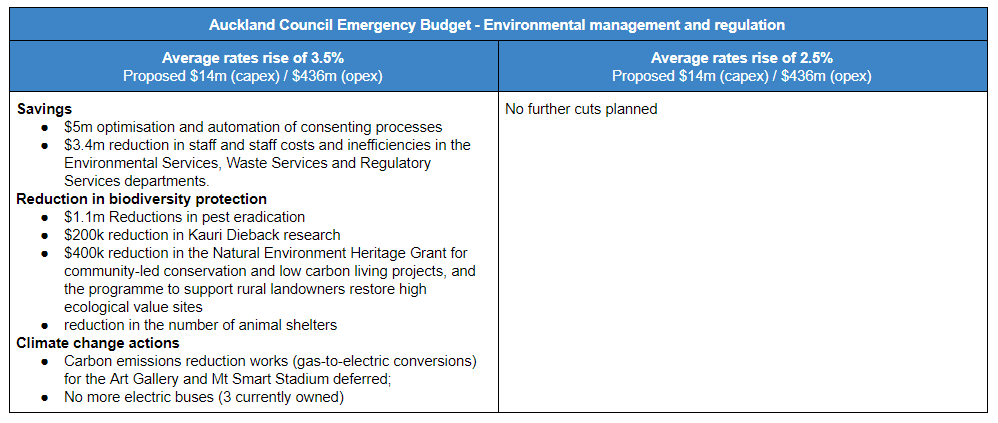
Zero percent would mean delaying the climate change initiatives proposed in the first round of consultation and not resuming inorganic collection services leading to increased illegal dumping.
It’s great to see investment into automation and process improvement, although it shouldn't take an economic crisis to get underway. Auckland Council has never excelled at ensuring compliance to regulations and I’m concerned that we’ll see more issues with damage to our waterways and environment.
Council Support

I suspect there are a lot more efficiencies that can be gained here, although some are structural which can’t be addressed without dealing with the CCOs. Some of that will mean convincing parliament to pass legislation, which they haven’t shown any interest in.
So what does this mean for rates?
Council has just signed a new contract for the collection of refuse in the former Auckland City Council and Manukau City Council areas. The cost of the new contract has risen so the refuse rate will also be increasing. For context other parts of the city pay for their refuse collection with $3.95 bin tags each time they put their rubbish out.

Rates postponement scheme
Auckland Council is proposing a rates postponement scheme, which will be open to
residential and lifestyle ratepayers with a mortgage
financially stressed business and farm ratepayers. 85% of businesses.
Not-for-profit applications for residential property will not be required to have a mortgage
If you’re eligible, you’re able to postpone the first $20k (GST incl) of rates and carry forward up to $5k (GST incl) of any rates Q4. Applications can be made up until 31 December 2020 to allow time to fully understand situation.
In summary - a crisis budget
The proposed budget is drastic, cutting a lot of short term capital and operational expenditure. It’s tempting to suggest that this will mean less waste at council, but that wasn’t the focus of the proposal. There are some efficiency programmes planned which is great, but improvements should have been started years ago, not waited for a crisis.
I’m deeply concerned about the cuts to safety programmes, environmental management and public transport which will all have an impact beyond just money. I worry about our parks and community centres, already in a sorry state and further starved of funds they will become liabilities.
The missing information on the Community Safety Fund and Ormiston Town Centre make it difficult to fully understand the impact. I asked about these over a week ago and four days from when feedback closes I still don’t have an answer.
Driven by a looming economic crisis, quick decisions need to be made. But as we better understand the situation, we must reconsider investment. We must also take this as an opportunity to reflect on what we haven’t done when times were better - had we focused on park renewals, investment in transport and improving efficiencies we wouldn’t be so short today.
This budget is more than just a reflection of the economic realities, it’s also a portrait of a council that lacks discipline and robust governance. The public is being asked to respond to incomplete information, with cuts to what can be cut (rather than what should) and an ever growing backlog of under investment in infrastructure.
Feedback is open until midnight on Friday 19 June 2020.
https://www.aucklandcouncil.govt.nz/have-your-say/topics-you-can-have-your-say-on/emergency-budget/
Auckland Council's proposed emergency budget is drastic
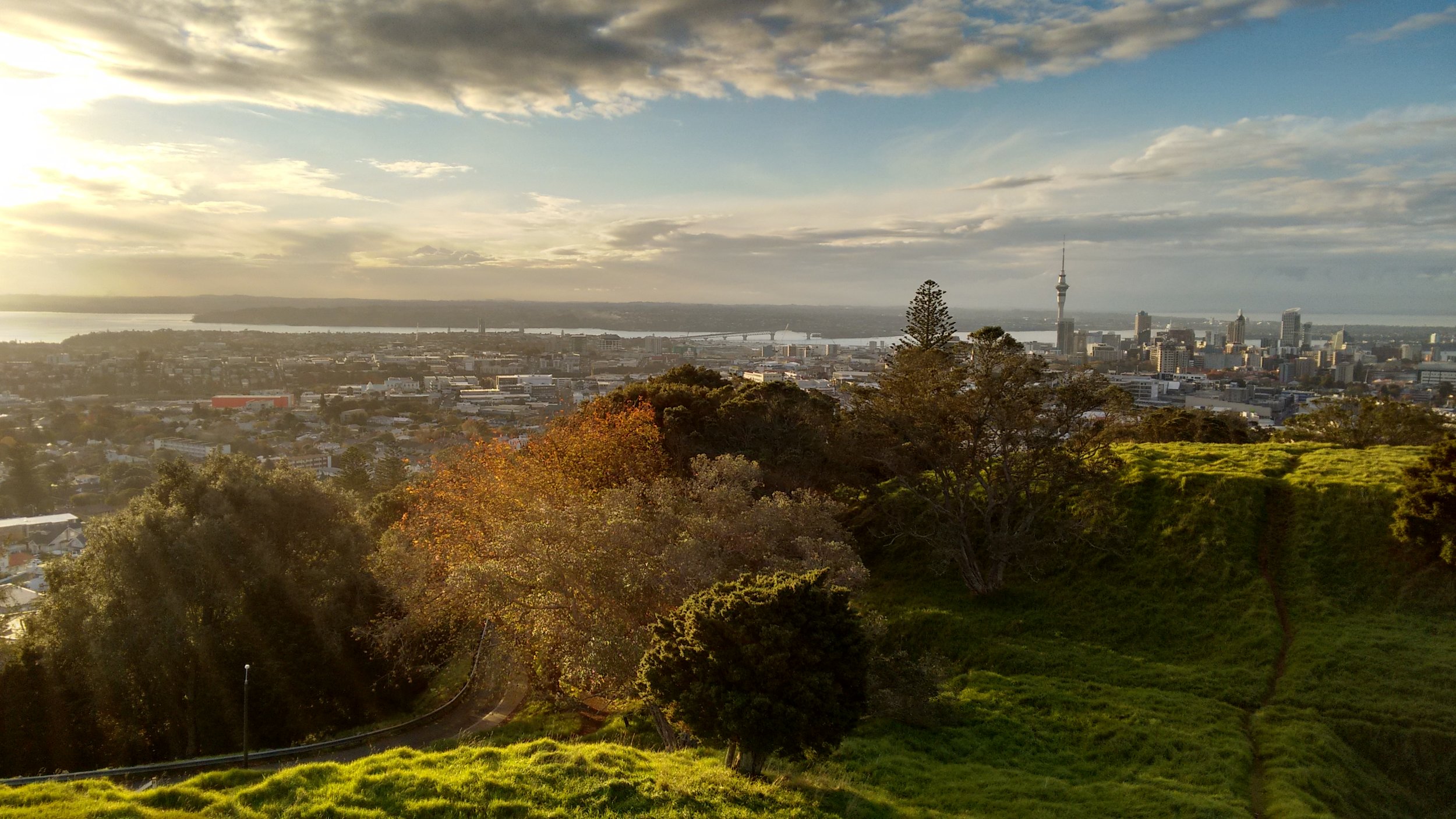
With everything that has been happening, we've become accustomed to drastic action in the face of a crisis. But even still, the proposed Auckland Council emergency budget is still a shock.
With everything that has been happening, we've become accustomed to drastic action in the face of a crisis. But even still, the proposed Auckland Council emergency budget is still a shock.
"Cutting road safety projects like fixing high risk intersections and pedestrian crossings. Stalling a much-heralded conversion to electric buses - a totem of the council's climate change commitments. Selling $200m in public land and assets. Putting off the city-wide revaluation of all properties."
Tim Murphy: Auckland’s budget cuts: a half billion too far - Newsroom
I have no doubt that some will proclaim this as a victory, as if this is just council forced to reduce spending to focus on core services. But this isn't how you improve cost effectiveness, reduce bureaucracy or focus on core services. I've worked in business improvement for over a decade and positive change comes through sustained focus, good disciplines and innovative thinking. This isn't that - it's an emergency response to a crisis, survival mode.
It's also true that businesses are being forced to make tough decisions - as the person who led the development of our new business plan at work, I know this well. But while there are areas where council could be more business-like, it's not a business. The impact of this budget will be felt for sometime, especially with cuts to environmental management and regulation (which has never been a strength for Auckland Council).
We’re being asked to consider the option of a 3.5% or 2.5% rate increase which is about $1.82 or $1.35 per week extra. We're paying more but will still see significant cuts into the operating and capital budgets over the next year to account for the massive drop in revenue. While Auckland Council has worked to leverage alternative incomes, there are limited options and those have been hit hard. I sympathise with the staff and councillors who have had to make some tough calls and still had to ask for an increase to rates. We cannot continue to rely on endless rates rises, but the blame lies with central government who have ignored those of us calling for local government funding reform.
Government has allocated themselves billions for economic recovery and a decent proportion of this should go towards local government. While Auckland is budgeting to be down $525m in revenue, estimates put the total nationwide gap for all councils at around $1b. A terrifying number for local government but less so for central government. Compared to the countries in the OECD, New Zealand ranks among the lowest in terms of the proportion of local government revenue that comes from grants and subsidies given by central governments.
It’s an election year and with UnitedFuture no longer around to champion localism, I’m hoping that the other parties pick up on the urgent need for local government funding reform. In the meantime, Aucklanders need to make sure their voice is heard by council.
We have until June 19 to respond online at akhaveyoursay.nz/emergency-budget, by phoning 09 301 0101 or visiting a council service centre or library.
I’m hoping to finish reading through all the materials this weekend and will post more details on the specific impacts on East Auckland.